|
Vintage Metal Artists Bio's
Click on "Sculptures For Sale" at the top the left
to select from dozens of fabulous Vintage Metal Art sculptures by vintage metal artists such as Jere, Bowie, Bijan, and more!
Below you'll find bio information on our favorite artists.
Subscribe to our free digital newsletter for more details and info each quarter All information on this site by groovywares.com is licensed under a Creative Commons Attribution-NoDerivs 3.0 Unported License . Based on a work at groovywares.com. (You may use or post any information on this site as long as it references groovywares.com as the source and includes a link to same. All digital rights reserved.)   Bijan (1936-2016),was a major force in the mid-century metal art movement and considered by many to be The Father of Metal Sculpture. In their mid twentieth century sales brochures, American Express referred to him as "The pioneer of metal sculpture" Sadly, Bijan passed away October 4, 2016 After hours of interviewing Bijan by Groovywares and biographer Linda Stoll we have a glimpse into the life of a man, few of us knew anything about. This biography opens up a wealth of new information about this great artist. This first article was written in 1969. It reveals some wonderful information about Bijan. Indeed, as collectible as his "department store" pieces are becoming today, his original works should skyrocket in value. (Subscribe to our free Groovywares newsletter for a copy of this article in it's entirety.)
When Bijan came to the United States, from Iran,
1959, he knew only a little English and had virtually no money. Bijan
was a handsome 22 year old Persian.
Bijan started by renting a little old lady's garage and creating metal sculptures. He sold them to private collectors: Frank Sinatra, Carol Burnett and Joey Bishop are some others, as well as public buildings. Someone suggested to him that there might be a market for his works with the general public. He rented a little bigger garage and started turning his works out in quantity. Local department stores gobbled them up. He decorates some of his works with glass marbles (with a technique he is now in the process of patenting) To keep his sculptures safe in transit, he packed them in popcorn, in the sixties. It is his artistic eye and technical skill - he uses new methods of working with metal - that set his sculptures apart. The ones he sold in stores, in the sixties and the seventies, ranged, in price, from $25 (for a metal sculpture flower) to $950.00 (for a glass top sculpture table.). However, an original Bijan for your home or your office building, the sky was the limit. Note that his low priced art of $22 in 1969 would cost $110 dollars in 2009 and $950 in 1969 would cost $4,545.00, I dare not speculate on how much "the sky's the limit" in 1969 $$ would be today.
Recently one of his carved crystal sculptures, The Illusion, sold for $35000.
Groovywares owns several of Bijan's rare etchings on metal as sculptures. On one etching is a sticker entitled - Biography. The sticker goes on to read, in part: "The credit of pioneering the field of metal sculpture has rightfully been given to Bijan. His massive architectural sculptures, murals, fountains, and paintings, his collection of bronzes, have made their homes on six continents. Bijan, who is so well known for his three dimensional sculpture in bronze, copper, and brass, who expresses his art form so superbly by using the natural richness of metal, his favorite medium, was also applied to his distinct style to Etched Engravings on metal. Everyone is a signed and numbered Limited Edition with a distinct character of its own. Many have already joined the Bijan sculptures in collections of distinguished art connoisseurs."
After hours of interviewing Bijan, Linda Stoll, has given us an excellent biography and a glimpse into the life of a man, few of us knew anything about. This biography opens up a wealth of new information about this great artist.
Bijan J. Bijan
Biography (By Groovywares and Linda Stoll)
BIJAN IS A RENOUND SCULPTOR, PAINTER, DESIGNER, INVENTOR AND PRODUCER, NOT ONLY HAS ENHANCED HIS TALENT OVER TIME, HE WAS BORN WITH THE EXTRAORDINARY ABILITY TO TRANSFORM LIFE INTO CREATIVE PROCESSES AND FORMS.
Overview: Bijan is a private man and does not share his life story freely. After spending hours with Bijan, I have come to realize that there are many great artists who might be greater than Bijan in many media and fields, but there could not possible be a single person with as much talent, expertise, technical knowledge as well as design sense in such a vast and unlimited areas as possessed by Bijan.
Bijan is even into writing novels, scenarios and music. He cannot read a single music note, but he can make music, even with a simple comb. He loves to compose music and like everything else he does, the execution of it, takes a back seat to the joy of the creative process. Whatever Bijan creates in his mind, he is capable of actually making and fabricating it with his own hands.
Most of what Bijan knows has been self taught, which has resulted in his designing many novel creations. Bijan proclaims, “Ignorance has been my greatest asset.†One must think hard to understand this strange comment. He has over a thousand inventions, but has not applied for a single patent. It is just not important to him. However, many of his ideas have been put into production by major companies, with great success.
Bijan has never had a benefactor, promoter, partner, personal manager or been involved in any fraudulent self promotions. Sadly enough, Bijan is the most under appreciated and under recognized person in art and design.
Bijan is truly a Renaissance man in its purest form; or is he an oddity and fluke of nature. You decide.
Bijan was born in Tehran, Iran in 1936 as Bijan Jazai Shokatfard. He came to United State in the spring of 1959, to become a "Doctor," fulfilling his mother's wishes. Medicine was not his calling, but art was. No one knew that at the time except Bijan himself. In 1972, he became an American citizen. He changed his name to Bijan J. Bijan because he was already very well known by the name Bijan nationwide as a sculptor, so the last name Bijan was the natural choice. Bijan has been married twice. He has two daughters and a son, as well as five grandchildren. He presently lives in Southern California.
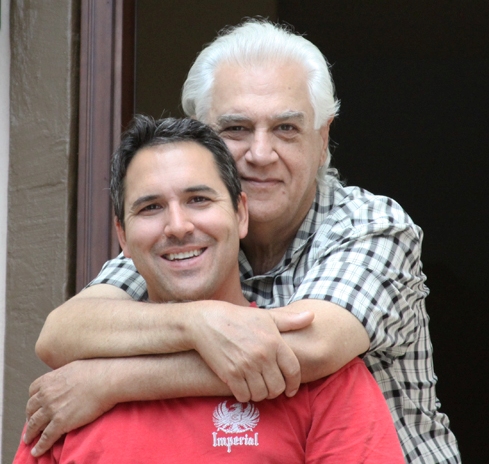
Below is a recent photo of Bijan son
His interest in art started at a very early age. When he was four years old, he used his mother's lipstick to paint an apple. It was so highly realistic in shape and shading that it amazed everyone. By the age of six, he was creating piggy banks and kites, totally new in design and construction. At nine he was inventing and making functional gadgets, with amazing accuracy, at his father’s factory in Iran.
Gifted with great curiosity and a fascination of nature he began to sketch, paint, and sculpt elements in his environment and continued this creative expression with great intensity during his formative years. With the encouragement of his parents, in 1959, he came to the United States. His first place of residence was in Sacramento, California, where he attended school. Many of his paintings and sketches were placed on exhibition, not a common event for a new foreign student.
He was spotted and admired by an official of the 1960 Winter Olympics Games at Squaw Valley. During that time Bijan was working on the painting, “The Beach at Lake Tahoeâ€. It impressed an Olympic official and consequently, he was introduced to Walt Disney, who was in charge of the Olympic pageantry and encouraged Bijan to do the painting for the 1960 Olympics. Bijan was elated and his professional career in art was launched. Using his imagination, he created the Olympic painting in the summer of 1959, the painting was signed "Bijan Shokatfard. Bijan was introduced to, then Vice President Nixon and his wife Pat, who were opening the Olympic ceremonies. Bijan was honored and elated to meet both of them. The Squaw Valley painting is now hung in the home of Bijan J. Bijan the Third, Bijan's son.
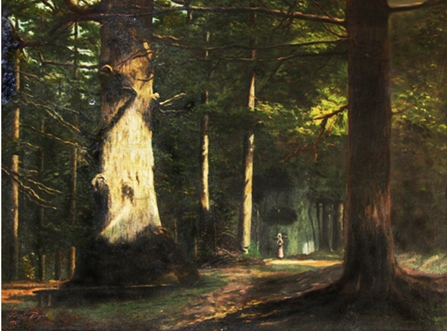
Mazandarin A Forest by the Caspian Sea This 1951 oil on canvas, was painted by Bijan, when he was 15 years old. In 1967 he added his newly developed signature to the painting.
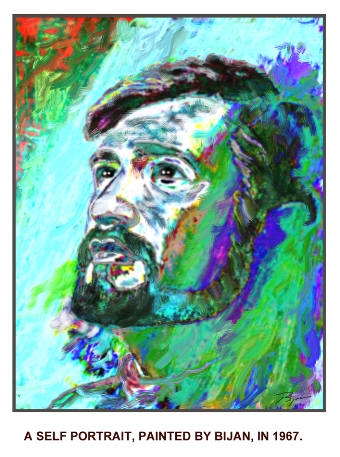
In 1967 Bijan painted this self-portrait:
In 1962, Bijan moved to Los Angeles where he attended the ArtCenterSchool of Design. At the same time he opened his art studio. He immediately began creating massive architectural works. He was amazed by the trust bestowed upon him and his work and was offered important commissions for monumental sculptures and design ideas.
In 1962, Bijan made an eighteen foot high Bass Relief ceramic wall sculpture, of a winged Griffin, an ancient Persian motif, for a building in Reseda, California. After the infamous earthquake in 1993, in the nearby city of Northridge, California, the only intact structure was Bijan's ceramic mural, which survived without a single scratch. At the time Bijan was commissioned to create the Griffin, he had no knowledge of ceramics. He had to develop his own techniques in order to achieve the end result. The building was eventually remolded to code and Bijan's masterpiece still remains on display and has become the symbol of the city of Reseda.
Bijan's metal sculptures were seen worldwide in the sixties and seventies, which is now referred to as the "Bijan Era.†This particular art form, with its special techniques and styles, is associated with Bijan. At that time, Bijan was referred to as,
"The Father of Metal Sculpture," although that title has been claimed by other artists as well.
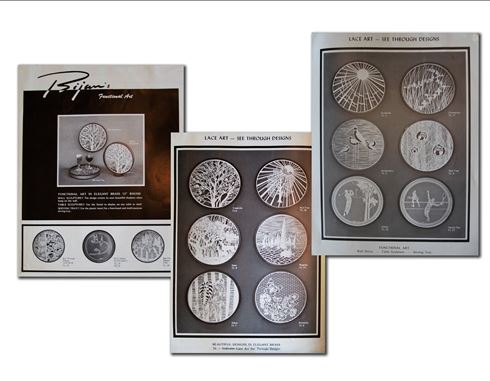
Tired of being repeatedly copied, in the mid-seventies, Bijan developed the perforated metal technology, through an acid etching process. This became his new art form. Bijan acid etching designs have now become the rarest form of art collected from this artist. It is a technique so difficult and dangerous to produce that it has yet to be fully understood or duplicated, by any other artist. The process was utilized for art as well as functional designs, such as Christmas ornaments, trays, clocks and numerous other applications such as coffee and dining room table, lamps and elevator door panels. Eventually, Bijan had to discontinue his chemical operation. It was too hazardous and highly dangerous a process.
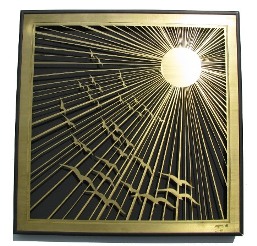  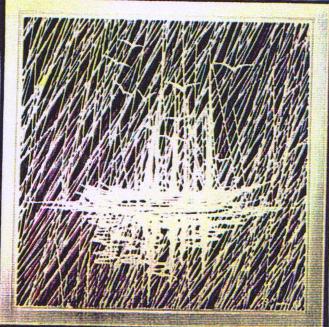 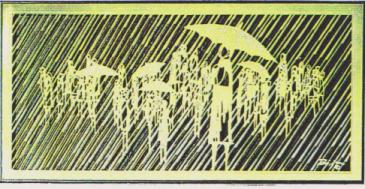
At times, Bijan utilized steel material for some of
his etchings, as well as his famous sculptures of black birds.
In 1975, the words “I Believe,became the name Bijan gave to his jewelry collection. It included necklaces, bracelets, and rings, as well as a few other applications. His jewelry designs were sold through select department stores. They were also offered as a fundraising gift by a number of religious organizations. Eventually, over two million pieces were produced and sold nationwide. A small number were produced in fourteen-carat gold.
By the early eighties, Bijan was producing his "Golden Bronze Sculptures.". It was comprised of a very thin castings process, polished and then bolted together, instead of being welded. Again he had developed a new art form. He incorporated porcelain as well as marble in some of his designs. Every material he used was natural and genuine. There was no brass plated steel, to be presented as real brass, as some artists were claiming, at that time. Bijan's work will exist five thousand years from now, while most other steel sculptures will eventually deteriorate and rust away.
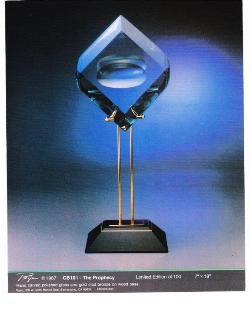
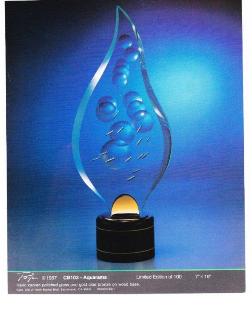
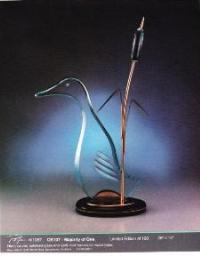
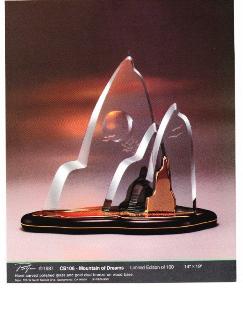
In the eighties, again, Bijan created a new art form at his studio in Florence, Italy. The series called “Clear Vision,was introduced as a Limited Edition of 50 to 100 pieces per design. Bijan's carved and polished crystal technique has earned him universal praise. These diamond carved designs have reached the ultimate level of perfection and craftsmanship, as it is an extremely difficult art form. This closed edition is now one of the most sought-after of all Bijan's work. These sculptures have been presented to dignitaries, as state gifts, as well collected by art connoisseurs the world over.
In 1982, Bijan carved the "Pieta," at his studio in Florence, Italy. He obtained a block of marble form the Carrara Mountains and started carving. To realize his mastery in carving marble, Bijan is the finest example of his abilities and understanding of natural stones. Bijan was simply intending to test his own skills on this very unforgiving material. Replicating a realistic figure such as the head of the Madonna the "Pieta," was an ultimate challenge. This one-of-a-kind work of art is simply a breathtaking masterpiece. 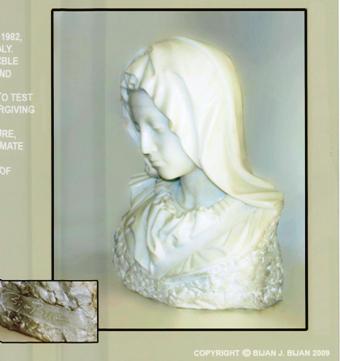
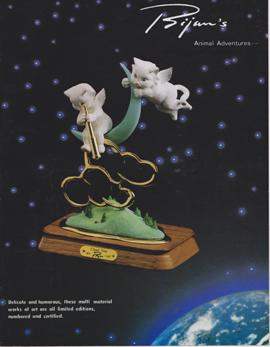
In 1987 he introduced his "Animal Adventures
Series." This was a unique combination cast poly, hand-painted and added bronze elements, mounted on
oak bases. The collection consisted of twenty designs with
an edition of 5,000 pieces each. This series created
quite a sensation at the time and triggered the "Poly
Revolution†in the Orient, which is now seen everywhere for many applications,
especially in the figurine and gift markets.
For almost thirty years, many prestigious companies such as American Express, Gumps, department stores and have presented Bijan's work through their stores and catalogs.
During his career, Bijan has been instrumental
in discovering, employing and training unknown talents, many of whom have gone
on to become famous and very successful artists in their own right. Paul
Wegner, whose bronze sculptures can be seen in galleries everywhere, is
one example. Wegner’s unique style of using only the heads and
hands of mostly African-American jazz musicians, holding
polished bronze instruments, floating in the air,
can easily be recognized. Paul worked for Bijan from 1974 to
1978. Paul's brother, Steve Wegner, worked for Bijan.
Numerous Bijan employees are now well-known and respected artists,
in the US, Italy, Taiwan and China.
Bijan combined technical mastery and a highly developed sense of style make his work unique. He is one of a few artists in the world who creates, designs, engineers, manufactures, and distributes his own work in the U.S., as well as internationally. The following statement would summarize Bijan in its purest and most descriptive form;“Bijan is a creative army of oneBijan is an industry!
Bijan has over five thousand original copyrighted designs to his credit. Today he is one of the most collected sculptors of our time. Millions of people own designs by Bijan, from one-of-a-kind masterpieces to everyday functional products. The people who enjoy and collect his work include heads of state, dignitaries, celebrities and a great number of enthusiastic collectors worldwide.
In 2001 Bijan created The WorldTradeCenter design and philosophy which was presented by the victims families. He introduced the 1776 foot high building idea of his unique, appropriate and emotional memorial park. It did not get the attention it deserved. The politics on this project were unbelievable. Bijan was not well represented in order to get his project reviewed by the proper authorities.
Bijans architectural designs and original ideas mark Bijan lifelong achievements. One example of this is the unique nightclub in Taiwan, in which Bijan designed a movie screen as the dance floor, projected from below. One would feel they were dancing on moving clouds, ocean waves, bead of flowers, or have the feeling they were falling or flying. Bijan himself wrote, produced, directed and edited the movie used on the dance floor. Bijan called his film “Cinedance.". It became a phenomenal success in the Orient in 1988. At the time of the construction of this famous entertainment center, Bijan's work was being examined by Professor K. Wong, of Taiwan University. Professor Wong was educated at MIT and Oxford University. He was the chair of the engineering department at Taiwan University. When Bijan was asked by the professor: “How did you calculate the metallurgy and strength factors? Bijan simply pointed to his nose. Professor Wong was so impressed that he shook Bijan hand and said, “I am honored sir; I have never met a natural like you! Many of Bijan other inventive ideas were used in this project, such as architecture, furniture and product design are all examples of his artistry.
Over the years, Bijan has transformed his creative visions into finished works of visual art, design and creative elements. Bijan has developed a deep understanding of the processes necessary to transform his dreams into physical realities. More often than not, when techniques did not exist, he simply invented them, in order to obtain the proper objective. Having done so, Bijan created a reputation and gained respect for his originality, artistry, technical knowledge material understanding, and ability to create works which received wide acceptance.
In order to truly appreciate his art, one must view Bijan actual work. Pictures simply do not do his three-dimensional pieces proper justice. Art, design and pure creativity have been Bijan’s callings. Knowing there are others with similar interests, Bijan lifelong ambition has been to create a unique art institute, dedicated to seeking out and training students with great talent. In this way, he could pass along his enormous bank of knowledge, know-how and experience in creativity, art, and design, at no financial burden to the students. For over thirty-five years, Bijan's name, signature and some of his principles of designs have been mercilessly pirated and capitalized on by unscrupulous individuals. Bijan has risen, at times, through extreme difficulties, using his resilience and his enormous will to succeed.
In recent years, Bijan has been on sabbatical from the business, but when he was not delightfully occupied by his grandchildren, he has continuously devoted his time to develop innovative designs and creative ideas.
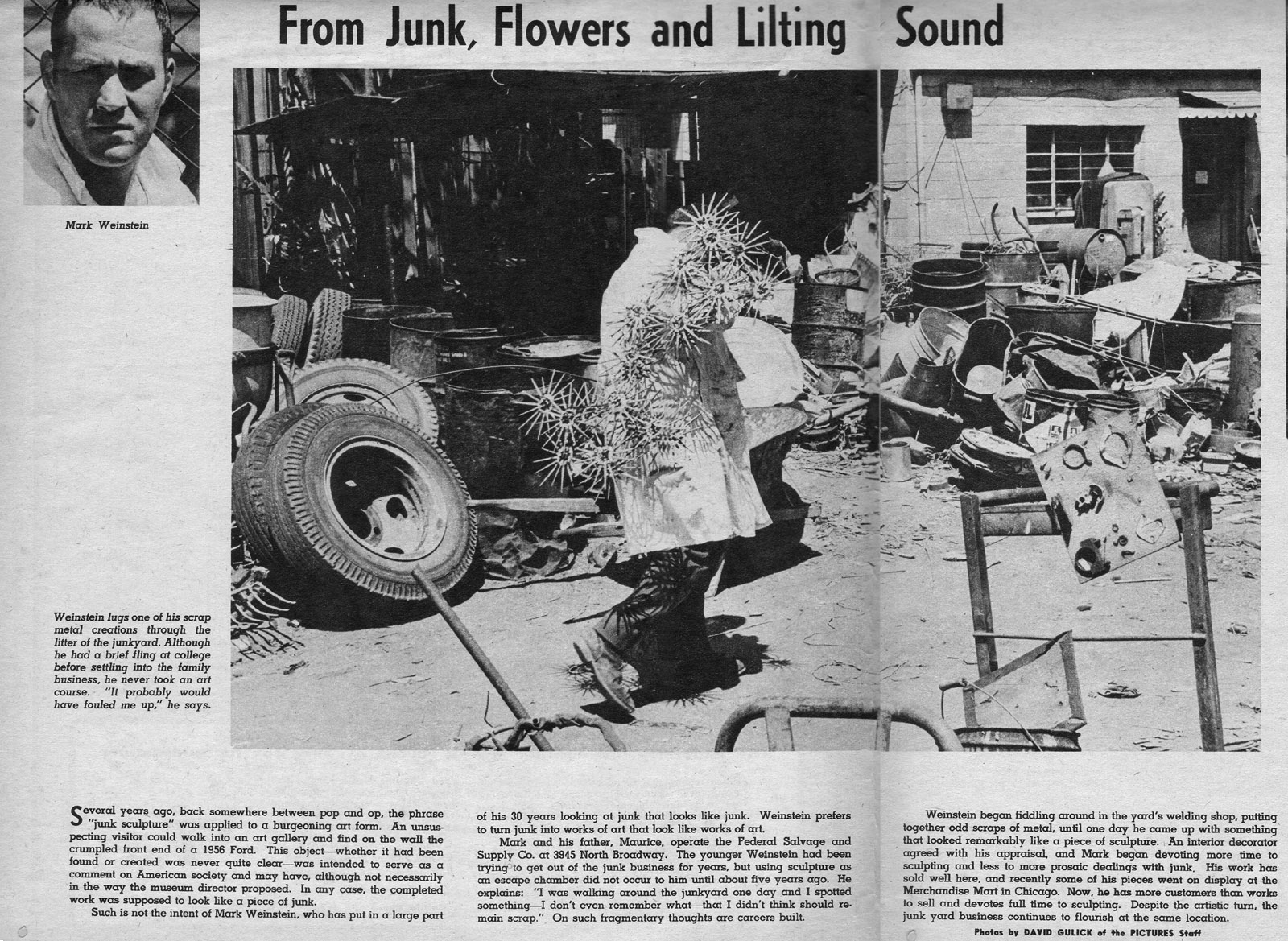
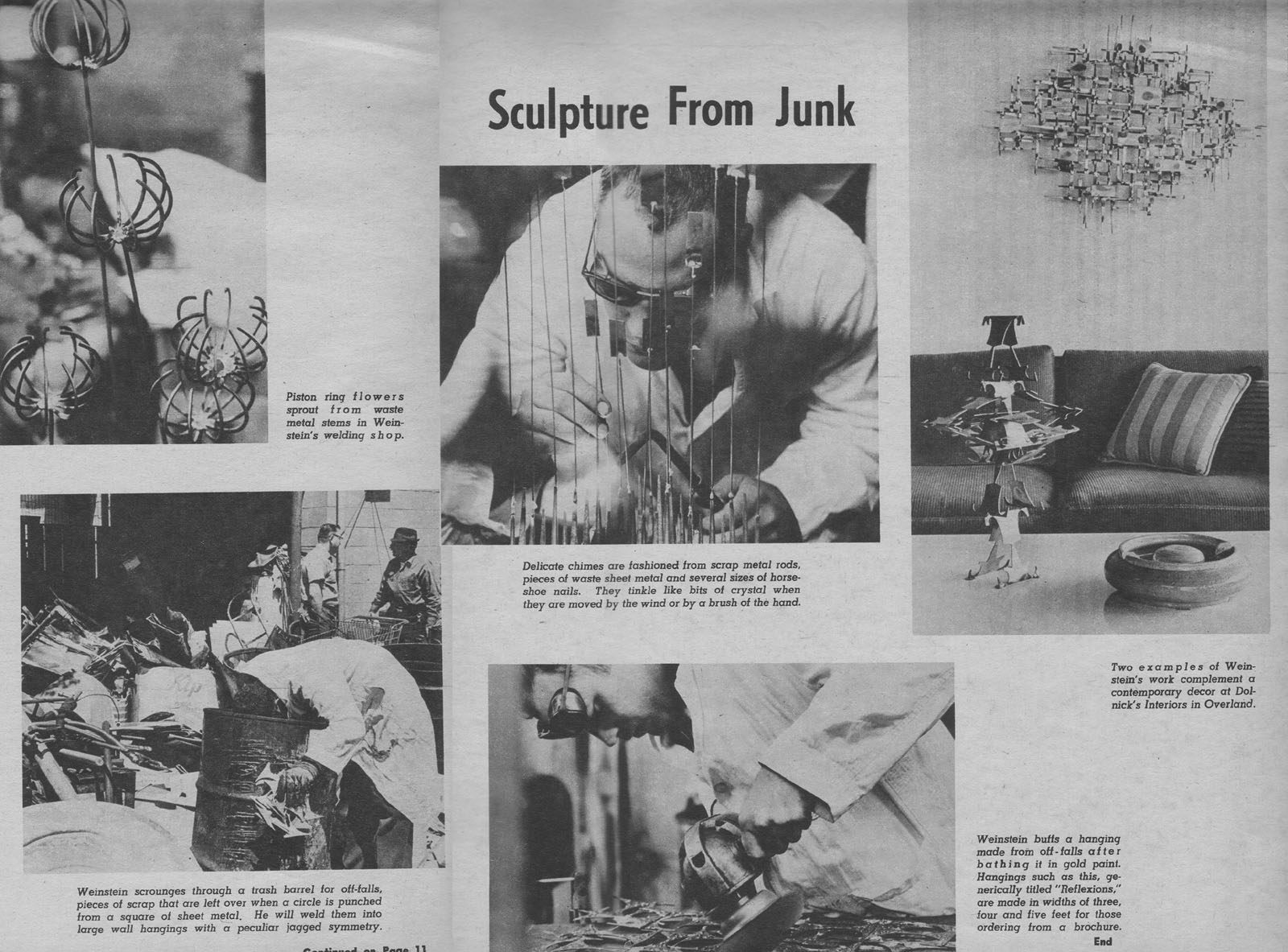
Mark Weinstein:
Note: As of January 19, 2014 Mark Weinstein's son Boyd has let me know that they are back in production. Check out their site at marccreates.com
The bio information below, with permission from Mark
Weinstein's son Boyd, was taken directly from the Marc Creates website at
http://www.marccreates.com/history.shtml
.
Mark Weinstein always had an
interest in art. Weinstein says he has always looked at things differently,
trying to see designs and images in everyday objects. He remembers looking at
books on nursery rhymes as a young child and seeing the space between the
drawings and how they relate to each other as images. Weinstein said,
"People look at a sign for a business and see letters. I look at the way
the letters interact with each other and they form a picture for me. Where
others might see words, I see symmetry, rhythm, and abstract shapes. I am
always looking at shapes unconventionally, always analyzing the area around them.
"
After Weinstein began working for his father at Federal
Salvage and Supply in St. Louis in 1957, he had a hard time seeing the scrap
metal as mere junk to be sold for weight. He found interesting shapes and
designs everywhere he looked.
Weinstein began experimenting with
different welding techniques after learning the basics from a local handyman.
Welding brought Weinstein's artistic abilities to the surface and by the early
1960s, he was transforming scrap metal into works of art.
Weinstein was carving out time to
create art during his workday and staying late at night. He spent the next two
years welding textured metal sculptures in a shed in the corner of his father's
scrap metal yard. What started as an artistic release in his spare time, was now
starting to consume his days. Weinstein said, "My Dad thought the
sculptures were interesting, but was also concerned about running a
business."
On a whim he took a metal wall
sculpture to a local furniture store to see if they would buy it. "The old
guy who owned the place didn't like it, but his son stopped me before I left
and said that he wanted it. He purchased the sculpture to sell in the furniture
store and it sold immediately," said Weinstein.
Shortly after he sold his first work, he was receiving
orders at a slow but steady rate until a furniture sales person spotted his
sculptures hanging in a store. The sales person contacted him to see if he
could carry his artwork. The sales person used Mark's sculptures to accessorize
the walls of a furniture show in Chicago. As a result of this exposure,
manufacture representatives from all over the country began to inquire about
selling his art.
By 1967, the demand for Marc Creates
metal sculptures was outgrowing the shed in the corner of his father's scrap
yard. In need of a full-time production facility and showroom, Weinstein rented
a building in downtown St. Louis. By the early 1970s, Marc Creates was
producing metal sculptures and furniture, shipping thousands of pieces of art
throughout the world.
Today Marc Creates multi-dimensional
metal sculptures can be found around the globe; they have been spotted on TV
shows, in restaurants and thousands of homes and offices.
1968 article published in the St. louis
Post Dispatch about Marc Creates (page 1)
http://www.marccreates.com/images/article.jpg
http://www.marccreates.com/images/article2.jpg(page 2) Marc Creates 1974 brochure: http://www.marccreates.com/brochure.pdf 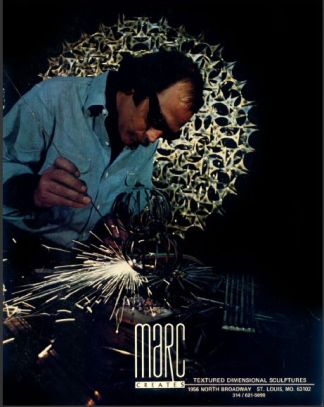
Curtis Jere:
The founders of Artisan House, Jerry Fels and his brother-in-law Curtis Freiler, started the company in 1964 with the goal of creating high-quality metal art that was accessible to a wider audience. The name "Curtis Jere" was a combination of their first names, Curtis and Jerry, with the addition of a French ampersand to create a more upscale image. The company produced a wide range of metal sculptures, wall art, and other decorative items, many of which are highly collectible today.
The
creative half of the duo was Jerry Fels, As head designer for Artisan House in
the early days he is the person that people like to think of as “Curtis Jere.
Indeed, in a 2007 interview with Mr. Fels published in Modernism Magazine
shortly before his death the article read in part, “Jerry Fels, California Artisan
House's longtime design director and president, is the 'real' Curtis Jere, the
elusive but influential metal artist. Renewed interest is being shown in Curtis
Jere's handcrafted wall and table sculptures, lamps and table bases which
capture the mood of California making the works among the most collectible
mid-century decorative pieces presently.
Jerry
Fels passed away after 90 talented productive years on November 5, 2007
Curtis and Jerry sold
Artisan House in 1972 but Jerry stayed on as head designer for several years. By
1978 another designer was creating many of the favorite c. jere designs that we
so know and love - BJ Keith.
Here is a quote from an email conversation that Groovywares
had with BJs daughter ,
Linnie Aikens, after listing a 1980 giant Jere can opener last
year:
“ My mother
designed this piece in 1970 or 71 when I was either 10 or 11. It was her very
first piece for the Artisan House and the first of the kitchen utensil
collection. She is quite famous in the metal sculpture field now. Her work has
been in Architectural Digest, American Bungalow (article "An Artists
Bungalow") as well as in too numerous to count exec offices on television.
She actually learned to weld on this piece it was her ticket in to Artisan
House! Jerry Fels was an inspiration and my mother's mentor and good
friend.
As his protege, beginning in the
late 1970's B.J.Keith grew from designer to top designer when Fels moved to
Colorado. She served as Art Director for the company for at least a decade,
teaching and helping other artists to perfect their skills, and recently
retired from full-time after 30 years with the company.
BJs
daughter Linnie maintains a wonderful Blog about her Mom at
http://quietpanache.blogspot.com/
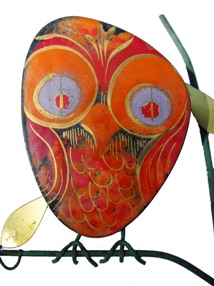
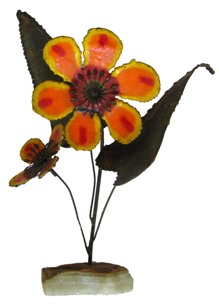
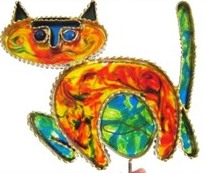
Artisan House still produces wonderful metal sculptures including reintroductions of popular mid-century designs. Artisan House sculptures are no longer made in California. Production went overseas to China in 2003. Vintage C. Jere works are highly collectible and can sell for thousands of dollars. C. Jere works range from representational to highly abstract. Some of the older techniques, such as enameling, the use of resin, and the bronzes, haven't been used in decades. Examples of 1960's Jere piece using enameling: Artisan House, under the Curtis Jere brand, produced a range of enamel sculptures in the late 1960's and early 1970s. These enamel pieces were often made using bright, bold colors and featured things like birds, owls,flowers,and organic, abstract shapes. They were popular for their use of color and texture, and their unique sculptural form. Enamel sculptures were created by applying layers of enamel paint onto metal, then heating the piece to a high temperature so that the enamel fuses and forms a hard, durable coating. The process allowed for a wide range of colors and textures to be used, and the resulting sculptures had a smooth, glossy finish. Enamel sculptures require specialized equipment and techniques, and the process can be time-consuming and expensive.
Examples of 1960's Jere sculptures using RESIN:
Examples of 1960's Jere BRONZE sculptures: The sculptures were typically created using the lost wax casting method, which involves creating a wax mold of the sculpture and then casting it in bronze. The bronze sculptures by Curtis Jere were produced in limited numbers, making them even more rare and valuable to collectors. They were also typically expensive than the metal sculptures due to the cost of the materials and the labor-intensive casting process.
The Gumps sticker below - still attached to a 1968 Curtis Jere sculpture, in indicative of the way Jere was promoted in the 60's and 70's. It talks about Curtis Jere but is really referring to that "Talented Mr. Jere", Jerry Fels. 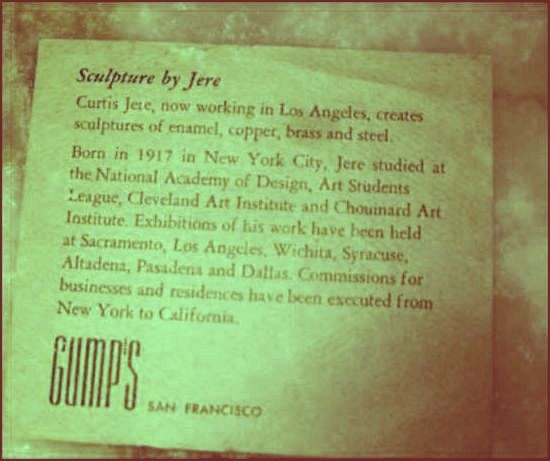
Many Jere art references from top designers and top design magazines can be
found online.
Here are a few examples: "From Metalwork to Modernist Furniture, Curtis Jere Was the Ultimate 20th-Century Maker" by Jane Drinkard, Architectural Digest, May 2021. "Curtis Jere: The Sculpture Studio That Defined 20th Century Decor" by Tabitha Teuma, The Culture Trip, December 2020. "Why Curtis Jere's Unconventional Metal Sculptures are Making a Comeback" by Helena Nicklin, Culture Whisper, December 2020. "Curtis Jere: The Company and the Artistry Behind Mid-Century Sculptures," 1stdibs Introspective Magazine, August 2018. "A Brief History of Curtis Jere – the Sculpture Studio that Defined Mid-Century Modern," Modern Shows Journal, October 2017. "The Art of Curtis Jere: Finding Treasure in Metal," Skinner Auctioneers and Appraisers, March 2016. "Why Curtis Jere's Mid-Century Sculptures are Still So Coveted Today," Sotheby's, May 2019 "Why Curtis Jere is the Midcentury Designer You Need to Know," House Beautiful, November 2018 "Curtis Jere: The Forgotten Name Behind Mid-Century Metalwork," The Guardian, May 2017 "Curtis Jere Wall Sculptures are Back in Fashion," The Telegraph, August 2016 "The Art of Curtis Jere," T Magazine, New York Times, May 2015 "Curtis Jere: The Artisanal Movement's Godfather," Architectural Digest, October 2014 "The Resurgence of Curtis Jere," Architectural Digest, February 2012 "Metal Men: Curtis Jere's Mid-Century Sculptures," The Wall Street Journal, May 2012. Elle Decor - November 2010 - Great article on Curtis Jere entitled "The sculptural ornaments of C. Jere By Mitchell Owens - Page 128 - Mitchell Owens traced the history of C. Jere, saying that the '60s and '70s pieces "are attracting the admiration of leading dealers in vintage chic." Dickenson, Susan Pyle (2008). "Made of Mettle," Home Accents Today In a 2009 House Beautiful article, dip-in-the-blue designer Frank Roop calls Curtis Jere pieces Highly collectible. New York Magazine mentions Curtis Jere art on "the it list" Feb. 2008 http://nymag.com/anniversary/40th/strategist/43901/ Dwell magazine - February 2008 - http://www.dwell.com/articles/nice-looking-glass.html Stuff Magazine - July 2009 - retro wall sculptures are suddenly hot, especially those in the style of Curtis Jere http://stuffboston.com/hot100-2009/archive/2009/07/28/hot-art-wall-sculptures.aspx Elle Decor, November 2007 Elle Decor Magazine (UK Edition) July 2007; Curtis Jere Metal Wall Sculptures are the current Hot Shopping. They called jere sculptures, "Possibly our top vintage discovery this year". Copper In the Arts November 2009 (Google this link instead of direct because direct link may be broken) http://www.copper.org/consumers/arts/2009/november/homepage.html Jere sculptures are often featured in top designer magazines. A few to look for: Elle Decor December 2009 (raindrops mirror) Traditional Home 2009 http://www.traditionalhome.com/design_decorating/howwelive/sibling-revelry_ss3.html (Boat)
Metropolitan Home December
2009
(table sculpture)
Elle Decor November 2007 (Sunburst)
Architectural Digest March
2008 (Raindrops Tree)
Architectural Digest December 2008 (1968 starburst sculpture) Architectural Digest September 2007(Rare 1965 jere wall sculpture and a lamp)
Interior Design
Magazine
Oct
1, 2009 (Lamp)
Interior Design Magazine Jan 1, 2008 (raindrops)
William and Bruce Friedle
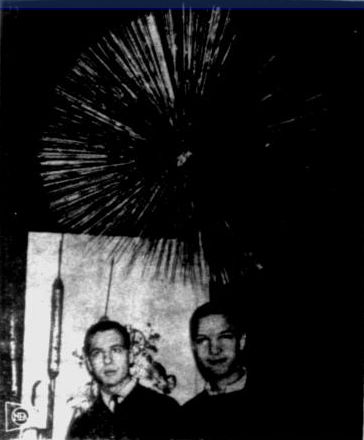
William Friedle and his brother Bruce ran a metal sculpture shop in New York City during the early 60s. The Brothers grew up in Rumford Maine and graduated from New York University. Their artistic careers took off when William won a New York decorating contest for a new apartment house. His entry? A large steel rod sunburst, suspended from the ceiling of the lobby. Suddenly William was being commissioned to do starbursts for doctors' offices, churches, department stores, banks, and high-end living rooms. It was then that he brought his younger brother Bruce on board. Shortly thereafter William and Bruce Friedle were commissioned by the American Iron and Steel Institute to create the decor for the "Home of Steel" exhibit at the Chicago Museum of Science and Industry.
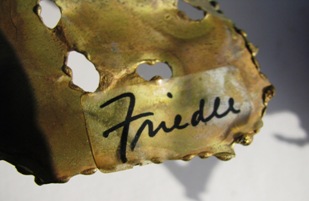
Working with brass and copper William and Bruce Friedle were metal sculptors who opened a showroom called Sculptsmith in 1961. It was located at 138 West Tenth Street in New York City's Greenwich Village, which was a thriving artistic community at the time. They specialized in creating brass and copper abstract sculptures, with their most popular designs being the sunbursts. They created both floor and wall sculptures, with the largest and most expensive being a 5-foot-tall weeping willow tree that sold for $400 at the time. Their sunburst designs are credited with introducing the sunburst design/movement of the 1960s, and many consider the Friedle brothers to be the originators of mod metal starburst designs. Their starburst designs were especially popular during the 1960s, and their collectors included Malcolm Forbes, Sammy Davis, Jr., Henry Morgan, Jim Henson, former President Nixon, Ted Kennedy, Dom Delouise, and many other notables/collectors. By the time Bruce was 25 years old he owned 5 Rolls Royces and a few homes on Long Island. Most of their work was unsigned (they just didn't feel like signing it!) or 'signed' with a paper label. While William Friedle retired in the very early 70's; Bruce continued until his last show (World Art Expo, NYC) in 1985 which featured his later "Amercan Whimsical Folk" art Bruce Friedle's last location at 304 E 76th St New York , NY closed in the early 1990s.
In 1963 the newspaper enterprise advocate of New York wrote this about the Freidle brothers: (source: The Victoria Advocate Oct. 13, 1963):
The photo below is of the two brothers standing in front of one of their starburst sculptures in 1963
Authentic Friedle signature sticker:
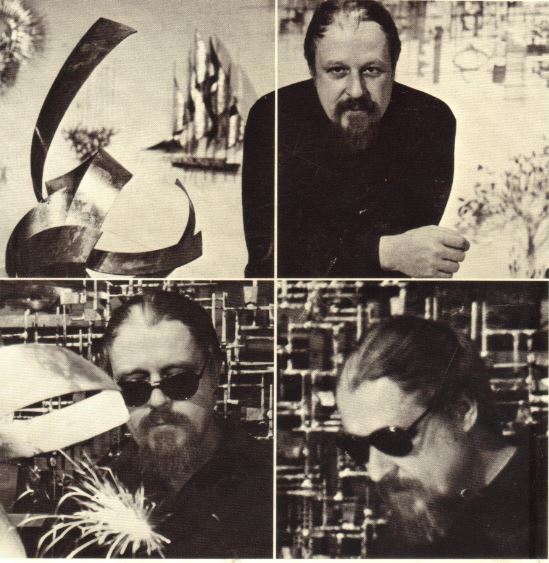
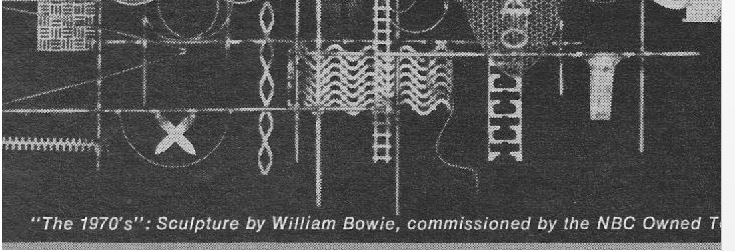
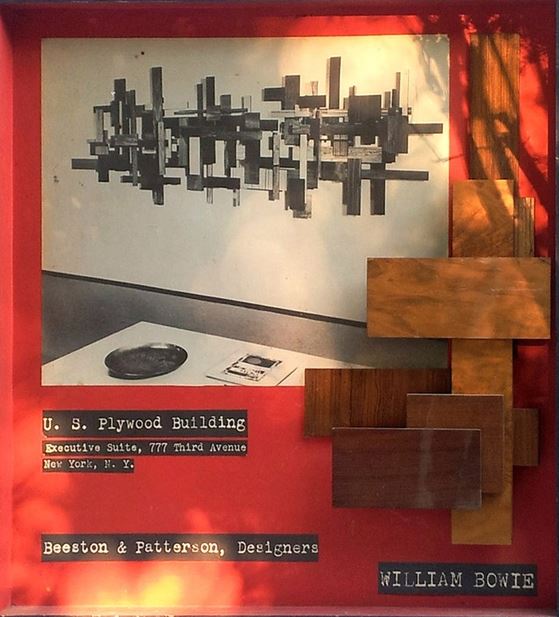
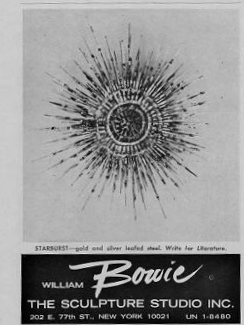
William Bowie
(1926-1994) :
Bowie's sculptures are in many private collections and museums throughout the United States and the world, including the Smithsonian American Art Museum in Washington, D.C. and the Hirshhorn Museum and Sculpture Garden in Washington, D.C. Other museums that hold Bowie's works include the Museum of Modern Art in New York, the Brooklyn Museum, and the Chicago Art Institute, among others. He continued to work as a sculptor until his death at 76 in 2003.
(A future issue of groovywares newsletter will have a picture & description of this sculpture)
An example of massive sculpture, nearly 6 feet across both ways, commissioned for a private collector in 1969 for $4,000 at the time - is shown below: 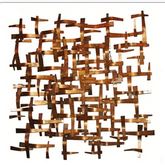 In the early 70's Bowie sold three sculptures through "The Collector's Guild". One was the beautiful Bowie Butterfly sculpture shown below. This advertisement described it as a hand crafted original that takes on the illusion of light. 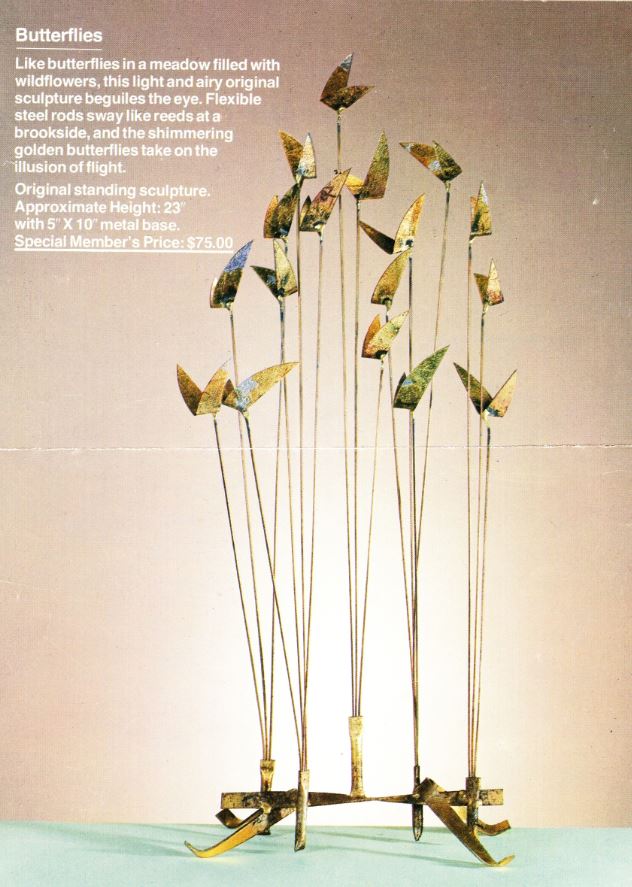
William Bowies late 1960’s catalog stated “ Sizes given are approximate. Each work is individually made and will differ slightly from the photograph, with
possible small variations in measurements†“Special commissions may be designed to order or based on the sculptures shown, which can all be made in other
sizes as required.â€
|


 - smallest.jpg)
.jpg)